Friday, March 8, 2024

SLO Mission Controversy re: Annihilation of the Grizzly Bears in 1772

My time on the Dave Congalton show on 3/6/2024 with fellow Mission SLO docent John Ashbaugh. You can listen to the podcast at the Congalton Show web page: https://www.920kvec.com/show/dave-congalton-hometown-radio/

During the discussion on the show, an issue came up that I want to elaborate on. I am very aware of the many controversies about the Spanish California Mission System, which was operational from 1769 (when Mission San Diego del Alala was founded as the first California Mission) to 1834 (when Secularization of the Missions occurred after the Mexican Wars for Independence ended in 1821).

A person texted in to the Congalton Show, who was critical of a comment I had made about my interpretation of Mission SLO history. I intend to set the record state here. Thanks for listening.

I commented that in 1771 - 1772, Mission San Antonio and Mission Carmel were in dire straights, and were starving. Lt. Pedro Fages, commander of the Presidio of Monterey, lead an expedition to San Luis Obispo to harvest bear meat. It was written down in the contemporaneous Spanish records that the local indigenous people were grateful for the Spanish "Soldados" who were able to kill 103 grizzly bears in "Los Osos Valley" (Valley of the Bears!). Many of the Indians had the tell-tale scars from surviving vicious grizzly bear attacks. Apparently, the local Indians were not able to hunt and kill the big, scary, aggressive grizzlies.

A person texted in a critical comment about my statements of "apparent" fact. For some reason, as I am re-listening the the podcast of our show with Dave, it does not record the critical comment, so I'll have to paraphrase it. The texter criticizes our statement that the natives were grateful for killing the bears, and that we were somehow condescending in making that statement.

Did the Spanish come to SLO and harvest grizzly bears? Yes. That is a historical fact that nobody disputes.

Did the local Indians bear scars from frequent violent encounters with grizzly bears? Yes. That too is a historical fact that nobody disputes.

Were the local Indians grateful for the extermination of so many Grizzlies? That is the historical fact that is in dispute. Though Spanish contemporaneous record this as fact, is it actually true? IMHO only, it is HIGHLY LIKELY that this was true. Given
(1) the apparent abundance of grizzlies in Los Osos Valley,
(2) the likelihood that the Indians could not get rid of them,
(3) the bears posed an ongoing threat to the lives of the Indians,
it is likely that the Indians were indeed grateful for the Spanish, at that point in time. Am I 100% certain that the Indians grateful for this act of annihilation? Nope. I'm maybe at 90% certain.

I would love to hear from the local native American communities about their opinion on this topic. That is one of the many reasons that we would benefit from the local tribes participating in presenting the Spanish Mission History to the Public.

In general, I always point out to the public that just because the Spanish wrote down their thoughts and impressions of the events as they occurred, it doesn't mean what they wrote was actually true!

**************************Steve McDonough

Thought you might enjoy this background information on the California Grizzly. I am amazed how many there were. I know Portola was attacked moving up Los Osos Valley. Seems like they were very aggressive to anyone they spied. https://www.naturespeace.org/grinnell1938grizzlysierra.htm
 
**************************Tim Waag
Quote from the "Grinnell Essay" referenced above (this quote proves the abundance of Grizzly Bears in and around San Luis Obispo): " Another purpose in bear killing is in evidence in the reminiscences of George Nidever. In the year 1837 he shot 45 grizzlies in the neighborhood of San Luis Obispo; and altogether during his wanderings up and down the California coast he thought he had killed "upwards of 200 grizzlies. Judging from the tone of his narrative, Nidever's chief motive in killing these bears was to demonstrate thereby his accurate markmanship and his cool-headedness. His superiority in these respects over his fellow frontiersmen was a matter of great pride with him. "At this time," he says, "there was no sale for bear skins, so that we never took the trouble to skin them unless for our own use or to make a present to some friend or acquaintance."
 

Tuesday, March 16, 2021

Part I: The Mission Economy from 1768 to 1834

Part I: The Mission Economy from 1768 to 1834

Introduction: From 1768 to 1810, Spain planned and executed its "Sacred Expedition" to colonize and possess Alta California to ward off the looming Russian incursion. During this time, it was illegal for the missions to trade with anyone except Spain and, of course, the local Indians. During the Mexican Wars for Independence from 1810 - 1821, however, there was no support received by the missions from Spanish Mexico, but also no enforcement of the ban on trading with other countries outside of Spain. 

With the overthrow of Spain in 1821, Mexico and the rest of the Spanish New World (Caribbean, Central America, South America) had their hands full struggling to establish their own new world order. Thus, from 1821 - 1834, the missions continued without meaningful attention or support from Mexico. Trade in the form of barter expanded with other countries who had been venturing along the California coast since the 1780's with the advent of the sea otter fur trade. Finally, the mission era ended when independent Mexico issued final secularization orders to disband the Spanish mission system around 1834.

Economic Structure: In 1768, Fr. Junipero Serra, O.F.M. and Visitador-General Jose de Galvez planned the economic structures of the first two missions (San Diego and Monterey). Two missionaries would be assigned to each mission and each would receive an annual stipend (i.e. salary) of 350 pesos from the "Pious Fund" (later raised to 400 pesos). The Pious Fund was set up in Lower California by the Jesuits in 1698 in order to fund the missions with monies donated by wealthy Spaniards who hoped it would ease their way into heaven. Viceroy Croix also allowed 1,000 pesos for the founding of each new mission, which also came from the fund. The newly established structure caused heated conflicts between the missions, presidios and Spanish bureaucracy throughout the entire mission period.


San Blas: The new port of San Blas (see map) was founded by Galvez in 1768 with 136,000 pesos from the Pious Fund. The small harbor was to transport supplies to Alta California via sailing vessels (see map). In the early days of the missions, the colonies relied on supply ships to bring foodstuffs to ward off starvation while mission agriculture was being established. In later years when the missions became self-sufficient, the shipments provided tools and religious supplies which could not be manufactured by the colonies. Indian laborers and skilled Spanish craftsmen were also transported via ship.


Mission Re-Supply: The Spanish had a difficult time navigating the California coast in their small crude "packet" ships. This mission supply line was unreliable, as sailing along the California coast was difficult and time consuming. Voyages were often delayed due to lack of supplies, bad weather or sick or missing crew members. 


Land re-supply was tried, beginning with the Portola overland expedition of 1769 - 1770. It didn't help that there was a chronic shortage of mules for transport, or that the route to the missions was long, hot and difficult. The "Yuma Crossing" was the only location where the Colorado River could safely be crossed by a land expedition to California. The "Yuma Massacre" of 1781 wiped out two recently established missions ("La Purisima Concepcion de la Virgen Santisima" and "San Pedro y San Pablo de Bicuñer") at the crossing and forced all future mission trade to occur exclusively by ship.


Mission Accounting: The mission economy was conducted on a barter basis, as actual cash transactions were only conducted in Mexico. Both missionaries and soldiers were paid in goods, since there was nowhere to spend pesos. Only after 1810 did the California economy begin to use currency as trade volume with outsiders increased. 


Each Mission and Presidio kept a detailed set of account books for domestic transactions to be used for the collection of debts in Mexico. There was little systemic procedures for making entries, and modern accounting principles were completely unknown. Thus, accounts were infrequently totaled and the exact standing of each mission was rarely known. To add to the confusion, individual economic transactions were also logged in these books, but debts were often ignored or overlooked. Fortunately, many of these books have survived and continue to reveal additional understanding of mission history.


Upcoming Part II: The Transactional Details of the Barter Economy


The “packet ship” San Carlos.

Sunday, July 26, 2020

"White" Jesus Controversy

Pandemic. Demonstrations. Riots. BLM. Saint Serra statues. Now "White" Jesus. 

Let's discuss?


BLM activists are saying "all murals and stained glass windows of white Jesus, his European mother, and all their white friends should also come down". They are a gross form of white supremacy. Tools of Oppression. Racist propaganda. 


They have a point. But have they gone too far? I agree that in a "perfect world", Jesus would look like the first century Galilean carpenter he was, not a Germanic, blue-eyed, marble white-skinned, straight-haired and bearded Jesus.


MLK wrote in 1957 that the color of Jesus' skin is of no consequence. His significance lay not in His color, but in His unique God-consciousness. Okay - that message is clear. But how did we get here? Let's look at history.

The Bible gives absolutely no clue as to what Jesus looked like - not how tall, not how big or small, no coloration or haircut clues - nothing. The first Christians did not depict Jesus in any way, honoring Judaism's ban on "graven images". They only cared about what He had done.

In the Christian world, the desire for images of Jesus and the Virgin Mary slowly grew as the centuries passed and Christianity spread to different cultures. These cultures tended to portray Jesus in their own likeness. The Greek's recreated Christ in the long-haired style of the Greek's sun god Apollo. Jesus is also seen as Romanesque in a classic beard and sitting on a throne, like Jupiter, king of the gods. Lacking any Biblical clues, these artists portrayed Him as they saw fit.

Above: gotta throw an image of me in there.
No, I'm not a Monk - but I portray a Franciscan for 
4th graders at Mission La Purisima in Lompoc.

However, the 7th century conquest of North Africa and the Middle East by Islam created a barrier between the Christian worlds, thus isolating Europe and it's Jesus artisans from its Christian brethren below. They were left to portray Him as a white European. So where did the "modern" mostly white image of Jesus come from?


It turns out that during the Middle Ages, a number of relics bearing the "true" likeness of Jesus miraculously appeared. They were claimed to be images created during His actual time on Earth. These relics, unsurprisingly enough, featured the long hair and straight beard that we associate with Jesus today. Also, throw in the famous "Shroud of Turin", believed by many to be His burial cloth, whose material retains an amazing likeness of the "bearded white Jesus" of day.

Above: Warner Sallman's 1940 "Head of Christ" 

In the late 1800's through early 1900's, white Jesus was indeed used by some as racist propaganda, and thus Jesus gained blue eyes and a lily white complexion - both rare in Christ's Middle East. Couple that with artist Warner Sallman's 1940 "Head of Christ" painting, which has been reprinted half a billion times, and you have turned Jesus into a glamorous and virile white man.


During the so-called "Age of Exploration" (roughly the 1500s to the 1700s), missionaries exported Jesus around the globe, and His likeness began to appear with the racial features of the local population. The most famous of those images is the "Virgin of Guadalupe" in Mexico, which depicts Mary with dark brown skin and straight black hair. As always, controversy over the depiction of Christ followed, wherever He went.

Above: Base of St. Serra statue at Mission SLO

Even the master Michelangelo was criticized during his lifetime for his depiction of beardless Jesus in the Sistine Chapel fresco of the last Judgment. Over in America, pictures of Jesus were rare well into the 1800's, as dominant Protestants were wary of promoting idolatry through Christ images. As more Catholics "crossed the pond", that began to change. The long conflict of the depiction of Jesus had finally come to America.

The controversy over "what should Jesus look like?" that has taken place over thousands of years continues today. In my opinion, that is a healthy debate that may be worth having for some folks, but not me. Destroying white Jesus images? I do not recommend it. Taking down white Jesus and putting up historically accurate, or locally-centric images? Sounds like a worthwhile undertaking, if there is a budget for it.


Peace and Love in these "weird" times.

Above: probably closer to what Jesus looked like.

Race and appearance of Jesus: https://en.wikipedia.org/wiki/Race_and_appearance_of_Jesus


Head of Christ:

https://medium.com/@mock/warner-sallman-and-the-branding-of-jesus-christ-4b711e5226b5

Another take on the "White Jesus" debate:

https://usagag.com/the-fallacy-that-christian-art-generally-portrays-christ-as-a-northern-european-man/

Mission La Purisima State Historic Park in Lompoc (where I am a docent):

http://www.lapurisimamission.org

Various visual depictions of Jesus through the ages:
https://en.wikipedia.org/wiki/Depiction_of_Jesus

Virgin of Guadalupe:

https://fsspx.news/en/news-events/news/our-lady-guadalupe-anti-pachamama-53487

Monday, March 30, 2020

SLO: Why Wait Until the Homeless Show Covid-19 Symptoms before Housing Them?

Note: All of our volunteers, including myself, are following the strictest Covid-19 exposure guidelines, despite reports to the contrary.

Our safety net is facing its biggest test in decades as a flood of people have flocked to homeless shelters, slammed suicide hotlines and packed food pantries. The economic shutdown is hitting the poor and working class with the most force, especially in cities like SLO with high homeless populations.

Before the virus was first detected, homeless shelters were already filled to capacity. In a typical week, numerous volunteers help run the shelters. But because of the coronavirus, few volunteers are coming. The demand on the paid staff is greater than ever, with surfaces needing to be disinfected regularly and people needing to be screened for symptoms. Beds now have to be spaced at least 6 feet apart to protect against the spreading of the virus.

Most of the chronically homeless (who do not stay in shelters) are in their 40’s, 50’s, 60’s, and 70’s, and their physical health is often more in line with people 25 years older. To make matters worse, showers trailers and restaurant / gas station restrooms have closed. As far as I can tell, the announced hand washing / sanitation stations have largely not appeared. In all my wanderings in the last week, I only saw 1 hand sanitation station, and that was outside the restroom at Mission Plaza. How does that help? The restroom was already open. With personall hygiene among the homeless so important right now, there is very little available.

Recently, homeless have been asking for masks and gloves, and we have none to give them. Eventually, when the Covid-19 spreads throughout our homeless camps, the homeless will swamp our medical systems, and will die at rates 2 or 3 times the average for their age. Then we’ll wish we had put them in hotels / trailers BEFORE they showed symptoms.
Final thoughts: There is a survey used by the "70 Now" (Housing First) program called the "Vulnerability Index: Service Prioritization Decision Assistance Tool" (VI-SPDAT), which is used to "rate" the homeless on their medical vulnerability, and thus their admission to the program. Basically, VI-SPDAT determines a rating for the relative likelihood that a particular homeless is most likely to die prematurely due to living on the streets. This survey could be used to determine who are also most vulnerable to the novel coronavirus / Covid-19, and house them before they get this virus and require hospitalization. Think about it.


Tuesday, December 31, 2019

CALIFORNIA SUCKS! Why? We do NOT Recycle the Ubiquitous Styrofoam Packaging

RECYCLE STYROFOAM? NOT SO FAST! Holiday season is often filled with gifts in cardboard boxes, packed with styrofoam to protect the contents. Time to look into what to do with styrofoam packaging. Result? So frustrating. Indeed, 25% of our land fill is styrofoam - is that really possible? Is that acceptable to you? It's not to me! It appears that it is almost impossible to recycle the stuff (see article). Your best best is to "store it and re-use it when you ship stuff" - huh? That is a ridiculous suggestion, IMHO (as in - where am I going to store it all?). https://www.hunker.com/12002950/how-to-recycle-styrofoam-in-california

Tuesday, November 26, 2019

Rich Old White People! Can't We Just Hate Them All?

Update 3/2/2021: Now that the "Standard Bearer" for the left is none other than "old white man" Joe Biden, isn't it funny how you no longer hear the libs complaining about it. As always, ridiculous and hypocritical. My personal approach is simple: support the best candidate, independent of race, gender or age. I only care about ability. "The only way to end racism is to end racism". I am too simple-minded to see it any other way - sorry.
 
Original Article: Hysterical how liberals have continuously bashed the "old white men" who crafted our amazing Constitution, particularly that stupid electoral college thing. The American Revolution started in 1776, and the Constitutional Convention took place in the summer of 1787. There were 39 signers of the constitution, with an average age of 44. The youngest was 26, and the oldest was senior statesman Ben Franklin, at age 81.
https://www.archives.gov/founding-docs/signers-factsheet
Contrast that with the "old white men" and one "old white woman" running for President on the Democrat side. Where's the criticism about "old white people" now? Not a word...not a word. How ironic. Age at inauguration for 2020 Presidential Race (January 20, 2021): - Bernie Sanders 79 - Michael Bloomberg 78 years, 11.2 months - Joe Biden 78 - Trump 74 - Elizabeth Warren 71 https://www.foxnews.com/politics/biden-sanders-and-warren-pressed-in-debate-on-age-health On his first inauguration day January 2017, Trump was 70 years old - younger than all the leading democrats will be when they are inaugurated when they win! Former President Jimmy Carter recently called for an “age limit” to the presidency. And 80, Carter said, is too old. Democrats insist that asking their "old white candidates" about their health has now become "out-of-bounds". It used to be that only asking about minor children of presidential candidates was out of bounds - my, how times have changed! Not for the better, IMO.

Tuesday, November 5, 2019

SLO "Blue Bag" Trash Pickup Pilot Program

**********
"Blue Bag Partnership" Link to Final Report
https://www.slocounty.ca.gov/Departments/Public-Works/Forms-Documents/Press-Releases/Blue-Bag-Partnership-Pilot-Final-Report.aspx

**********


"Blue Bag Partnership" Tim's "Mark-Ups" of the Final Report
Ann. I don’t expect any of this to be incorporated into the document, and all of it is at your discretion (of course) and those of the “partners”. However, I believe my comments to be accurate, and I believe you and I have discussed all these points before. I do want to put this information out there for your consumption (at least). Thanks!

Comment
Proposed Text Edit

********************
County of San Luis Obispo P a g e | 1

BLUE BAG PARTNERSHIP
PILOT EFFORT
N O V E M B E R  2 0 ,  2 0 1 9
C O U N T Y  O F  S A N L U I S O B I S P O

Results from the 2019 Inter-Agency “Blue Bag Partnership Pilot” Effort to Both Improved Stormwater Run-Off Quality and Increased Sanitation at the Homeless Camps

Sunday, October 20, 2019

Mission Well & Water Works Discovery at La Purisima Concepcion in Lompoc?

Author's Note: Future article for Las Noticias, the newsletter of the Docents of Mission La Purisima State Historic Park - Prelado de los Tesoros de la Purisima - loosely translated, means "Keepers of the Treasures of La Purisima."
Written in what I call my "Casual Conversational Style"! 
Word Count: 1,474. Enjoy...

All Photos: Click to Enlarge.

PHOTO ABOVE: Tim (left) with the esteemed Dr. Glenn Farris, Senior California State Archaeologist (Retired) https://www.parks.ca.gov/?page_id=23309
Cultural Resources Division. Read his warehouse paper many (too many?) times, and wrote my lowly article for Las Noticias (elsewhere on this site) based on his 28 page summary of his California State Park team's 1965 excavation. First time I have met him. 

Funny that Dr. Farris and I look a lot alike - I think (except I don't have any hair up top - but perfect for my role at La Purisima where I portray  a Franciscan!). Interestingly, my older brother came up with the correct term for this: tonsure (I hate that he is so much smarter than me, darn you - Will Waag!). Definition Tonsure: the Roman Catholic or Eastern rite of admission to the clerical state by the clipping or shaving of a portion of the head. 

Thursday, October 17, 2019

La Purisima’s Mysterious Warehouse (almacen) - UPDATE: By Tim Waag

UPDATE AFTER 10/19/2019 MISSION WAREHOUSE PRESENTATION GIVEN BY DR. FARRIS AT LA PURISIMA STATE HISTORIC PARK: 

The complete article (including these updates) can be found at:
https://timwaagblog.blogspot.com/2019/10/la-purisimas-mysterious-warehouse.html

You can find Dr. Farris' 28-page paper in PDF format here:
http://pcas.org/Vol33N4/334farrs.pdf

Dr. Farris gave a 1 hour presentation based on his 1965 - 1966 excavation of the Warehouse at La Purisima State Historic Park. I was able to ask many questions and get facts confirmed and questions answered. Here is my "shopping list" of information acquired or confirmed from that date. In addition, Dr. Farris sent me an email afterwards with 2 additional corrections, which are below. Many thanks to Dr. Farris for his tolerance of my many questions to him.
- (DR. FARRIS directed correction). Esteemed archaeologist Professor James Deetz of UCSB Archaeology / Anthropology was responsible for the 1960's excavation of the Warehouse, and Dr. Farris was involved in the 1965 - 1966 work.
- (DR. FARRIS directed correction). The warehouse structure was approximately 200 feet long and 58 feet wide - in contrast wit the larger La Purisimax Chapel and Residence adobe buildings, which were about the same width, but 300 feet long. The warehouse footprint was roughly 2/3 the length and the same width as the Chapel and Residence.
- There are no mission era records of Los Berros Canyon Warehouse construction. However, given the vagueness of communication back in that era, there is mention of a "Rancho San Antonio" Warehouse that was not far from the Purisima warehouse location. Dr. Farris believes it was possible that the Los Berros warehouse was misidentified as the Rancho San Antonio warehouse, though that seems unlikely. He showed a map of the Purisimax mission holdings that showed the Rancho San Antonio.
- Fr. Mariano Payeras, OFM did mention the warehouse in his correspondence during 1816.
- Fortunately for us that an 1850's surveyor actually took measurements of the Warehouse Foundation, so we have superbly accurate dimensions of the footprint of the building.
- The CCC may not have restored the warehouse along with the other major buildings at La Purisima because the warehouse was located on a different piece of property that was not retained for reconstruction by the CCC.
- A few other good Mission Warehouse examples survived long enough to be photographed or sketched. Buildings of similar functions at nearby missions often did not differ in design and execution. Examples of warehouse include: Temecula (Mission San Diego Assistencia), Mission San Francisco (William Dougal 1949 - Off For California: The letters, log and sketches of William H. Dougal, Gold Rush Artist. Edited by Frank M. Stanger with a forword by Joseph A. Sullivan)
- Confirmed that warehouse likely "stepped down" as there is a 9' foot drop from North to South along the long side of the warehouse.
- Warehouse rock foundation is 4.2 feet deep and much wider than the adobe walls at 4.5 - 5 feet wide.
- Few artifacts found at the warehouse during the various digs. For instance, only "one trade bead" found.
- "Cannon Bone" of a horse found at warehouse. Below the knee of a horse is the cannon bone which is also known as the 3rd metacarpal.
- "Matanza" (threshing floor?) found adjacent to the warehouse (see "Artist rendition" drawing which shows a threshing floor ). La era means "threshing floor" today. Today, Matanza means "slaughtering".
- Mission San Antonio and Santa Ines has a large circular stone "threshing floor" extant. 160 horses ran around threshing the flour! Indian's called out "yegua" (mares), "cambia" (turn) - it has been reported (somewhere in the historic record).
- Confirmed: There were no "cross walls" in the warehouse, which is unusual. Other warehouses had them, and it contributed to the stability of such a large adobe structure.
- Three infirmaries at La Purisima (many sick). 10 sets of rooms. Open rooms like a "field hospital". Should we know more about these structures.
- "Underreported structures" at La Purisima: Married Indian Housing, Warehouse, Infirmaries.
- Discussed leaving sites untouched for future exploration with "better methods" and perhaps (hopefully) "better funding". La Purisima has many such sites in these "under-reported structures".
END OF UPDATES. These updates have been incorporated into the article below.

ORIGINAL "LAS NOTICAS" (DOCENT NEWSLETTER) ARTICLE: After the massive earthquakes and flooding in 1812 destroyed the original La Purisima Concepcion site, the new mission across the Santa Ines river received a massive amount of building and growth under the dynamic leadership of Fr. Payeras. One of the first structures built at a new mission site is typically a storage building, as there is immediate need for securing food and property. Plus, in the early days, such a mission building often doubled as the church and shelter.


Wednesday, October 9, 2019

My Adventures in Pain and Life - 2019

My hideously ugly back. Now with railroad tracks. This is the only photo that I intentionally tried to save, because it is indicative (to me) of the whole experience. Also, I have permanent scars from my first back infection, where I put ice directly onto my back to ease the pain, causing my skin to be permanently burned and scarred! Stupid move, Tim!
CAUTION: Sue and I are "tag teamers' in raising our kids, work around the house, our law firm etc. If one of us is good at it, the other person does something else. This is the case here. I was struggling through some fairly brutal experiences in pain, trying to keep my wits about me and survive. Sue took on all the doctors and nurses and medications and treatments. As a first notch lawyer, Sue's legal skills matched perfectly with her skill as an advocate to monitor the medical treatment I received. Note also that I intentionally left many horrific details of this story out.
 
During this whole ordeal, Sue spent almost every night in my hospital room. On many nights, I would have her sleep in my hospital bed for a few hours while I sat up in a chair, then we switched and she spent the rest of the night sitting in the uncomfortable folding chair next to the bed while I tried to sleep in the hospital bed. Yes, the intensive care does not want spouses sleeping there, as no bed or even a comfortable chair was ever an option for us. I'm sure Sue was even more tired than me through this whole ordeal - she sure looked that way!

As of 6/30/2020, I was officially"cured", and I do not want to remember any of these horrific and painful experiences. Sadly, Sue may not be able to say good bye to them as efficiently as I will be. I cannot imagine what it must have been like to be told that your husband was likely to die right in front of your eyes. The first 2 times it happened, they just told me that I was likely to die "today". The next two times, the doctors looked us in the eye, and said there was only a small chance (20% if I recall correctly) that I would be alive tomorrow. Sue insists that same conversation also occurred a 3rd time on 9/26/2019, my 60th birthday, though I do not remember that one (Happy Birthday to me - maybe they slipped me some morphine or some other "wonder drug" so I wouldn't remember?).
The mountain bike ride that started it all. ABOVE: This is a photo of my friend on the mountain bike ride on the very day in the Irish Hills of SLO where I crashed (flew right over the handle bars - because unbeknownst to me, all the air had leaked out of my front shock), and the doctors believed the infected cut on my elbow got the staff infection started in my bloodstream, which necessitated my emergency back surgery, and started my "6 weeks of Adventures in Pain". From now on, I will buy and wear elbow pads when I mountain bike ride. F*** that staff infection.

INTRODUCTION: I'll confess. I spent most of the last 6 weeks in the hospital (back and forth between Sierra and French) with 2 of those weeks in intensive care. The medical staff indicated too many times to count that I might not make it through the day.
In my blood test today 10/8/2019, my hemoglobin shot up from 7 to a 10, which is HUGE, and in my joy, I decided to let the story out onto FB, where I still had many friends left to inform of this alternate world which I lived in for 6 weeks.

Anyways, looks like I may live. Thank G*D. New lease on life. Lost 25 pounds in the process, which I'll take. Thanks for everyone's support which I can NEVER repay. Larger-than-life thanks to my wife Sue and Dr. Ron, as well as the 100's of plasma donors across the country, plus the amazing doctors and nurses who diligently kept me alive at all hours of the day and night. Its not over yet, but its going in the right direction. BTW, I am now at home - no more hospitals for me!
Thanks to everyone in advance for your kind words, assuming you are glad I'm still alive. MY LONG AND WINDING MEDICAL ROAD: The pharmacist appeared to completely miss an undetected contraindication between 2 medications I was taking (never take these 2 medications together if you want to live). I always thought the pharmacists were supposed to catch these things, but we may have just signed the thing where we declined to be counseled - I just have no idea. The new prescription occurred about 1 month before my Adventures in Pain began. The culprits? Zoloft (depression medication) and Imitrex (migraine medication). Their combination created "heart attack" like symptoms that caused me to go to the ER at French (specializing in their coronary treatment center) several times with what appeared to be a massive heart attack. Nope. The contraindication of the 2 medications created massive chest pains, and profuse sweating, but no heart attack (you could have fooled me). A stress test brought my heart beat to the max for my age (162 beats per minutes) and imaging showed a flawless heart function with no blockages whatsoever - good news. Still scared the F out of me.
A few days later, I had an emerging back pain that turned excruciating over the next few days, and required me to be put under to deal with the uncontainable pain. The 2 best back surgeons in SLO county determined that I had a staff infection in my spine, and performed emergency back surgery to save my life (in the middle of the night). They told the staff that nobody was going home tonight, and that they had to operate on me now because I would be dead tomorrow. The back surgeons had to crack open every infected vertebra in my spine, and flush out the staff infection, performing a laminectormy on each one. The doctor noted that I have massive vertebra that required the largest spinal bone tools in their arsenal. While they were in there, they performed spinal stenosis treatment on my lower lumber L1-L5, and for that I was grateful. I no longer have any lower back pain whatsoever. Yay! A twofer there. Due to the extensive nature of the surgery, I stayed at Sierra Vista hospital for 9 days in recovery from my back surgery (see photo of beautiful new scar - I converted the image to black and white because the photo was so hideous). Turns out my "Adventures in Pain" was just beginning. While at Sierra Vista, I had a "PIC LINE" installed in my right arm in order for Sue to give my an anti-biotic IV drip 3 times a day at home to combat the staff inspection, and I finally got to go home after 9 days of fun at Sierra Vista Hospital. For the first week, the staff infection anti-biotic appeared to be working against the infection, and I experienced a slow and painful but steady recovery. Until I didn't. Apparently, the antibiotic that was doing such a great job on the staff infection, within the course of 4 or 5 days, turned on me and destroyed all my internal organs, causing my kidney and liver to fail. In addition, my red blood cells and white blood cells dropped to zero, my hemoglobin dropped to zero, and my platelets went from 300 to 4 in a matter of days. This is what death looks like, several of the doctors all told me. Thank G*D for our dear friend and local SLO General Practitioner and dear friend, who we reached out to during this crisis when our other doctors would not take our phone calls. She took immediate action, gave me a blood test, and at 11pm at night got the test back, told me I was about to die and we should go immediately to the Emergency Room. We went to Sierra Vista because they had all my lab data from my recent back surgery (we should have gone directly to French Hospital, as it turns out - what do we know?).

We may really know for sure what precipitated what. By this time, too many things were crashing all at once to understand all the interactions. As an example, when I was dropped into the Sierra Vista ER in the middle of the night after I was told that I was about to die, the staff took 17 samples of my blood from my left forearm in the first hour I was there (I had the PICC line in my right arm so that could not be used for clean blood samples). They wanted 17 separate "sticks" from 17 separate sources, so they could get accurate blood samples for the blood tests. How is it that there were 17 different things in my blood to test - I have no idea!
In the middle of that night Sierra Vista called French Hospital, and told them to get their their dialysis team out of bed and into the hospital immediately, as I was about to die without an immediate concentrated red blood cell dump, and plasma infusion. They initially wanted to wait until the next day, and I overheard the folks at Sierra screaming that was not an option, and to get on the phone and get your team into the hospital now. To their credit, they did. It turned out that getting enough plasma for a transfusion took several hours, as it had to be collected from storage around the county and the state. They installed a type of PIC line that went from my shoulder and into my carotid artery and directly into my heart. My first transfusion started at about 4am, lasted five hours, and saved my life.

French Hospital has special transfusion equipment that, thanks to the amazing, committed, and skilled transfusion team of Lee, Ben, and Mike, as well as my dedicated nurse for that evening, Ryan. I LOVE YOU GUYS - YOU DID AMAZING WORK WITH GREAT HUMOR AND COMFORT - I WISH YOU WERE MY FRIENDS FOR LIFE, BECAUSE I OWE YOU MY LIFE. In fact, by the time Ben had finished my first plasma transfusion, he was well past 24 hours into his shift - far beyond the call of duty, IMHO. He humbly shrugged it off. Turns out that night was the first of 9 days of transfusions, which were long, painful, and unpleasant in more ways than I can count. Profuse shaking, insane red rash over my entire body and a bit of psychological torture as well. A 6 inch pile of blankets over my body did not diminish the shaking one iota. The process consisted of pumping all the liquid out of my body, removing all the "bad" plasma from my blood and throwing it away, and inserting the plasma from dozens of anonymous donors into my body - like a night of Dawn of the Dead. Each transfusion consisted of me receiving 4.5 to 7 liters of the plasma from strangers who cared enough to donate so that people like me would live. Amazing. I owe these plasma donors a debt of gratitude that I will never be able to pay back, but I will try. You my friends, will be hit up by me for plasma donations for the rest of my natural life - no complaining please. I will make it my personal life's goal that the next person that needs plasma like me or they will die is DAMN WELL GOING TO GET IT - JUST LIKE I DID. This, my friends, is what makes America great. We care about each other, even though we don't even know the people we are saving.
ABOVE: In intensive care, you have your own private room, and at French that means you can have your dog for company. Go figure. Theo spent the better part of 3 days with me. Then I dispatched him home, the the IC is a miserable place for dogs as well as humans.

During 2 weeks in Intensive Care at French Hospital, we tapped out all of the plasma in California in my first 3 infusions, and the subsequent 6 infusions were done with plasma first collected from the western United States, and by the end, we were receiving Plasma from the east coast, including New Jersey in one instance. One night it looked like I would miss my treatment, until we got an airlift of plasma at 8pm that apparently came in from the Airport. That was long night of fun! Am I grateful for these anonymous donors - you bet I am!

During each day at French Hospital, the dedicated team or nurses and doctors were huddling every day in my room, trying to figure out how to keep me alive for another day. We described it like a game of JENGA - you have to pull the pieces out in the right order or the tower (that's me) collapses. The doctors were calling on their colleagues all around the state and country to get advise for how to proceed with the medical conditions I had that THAT THEY HAD NEVER SEEN IN THIS COMBINATION BEFORE - they had never had so many organ, tissue, and blood poisoning failures all at the same time.

The French Hospital staff doctors commitment was complete. I can't tell you how many times, in the middle of the night, my hematologist, or infectious dissease specialist, or hospitogist or other doctors that were working my case or even doctors we had never even met or heard of before - would wander into my room, and start to discuss new ideas they were considering for treating the many conditions that were all wrong in me at the same time. Bizarrely, sometimes they were examining me into the early hours of the morning.
ABOVE: Man's best friend.

On 5 separate days (Sue believes), I was told I was unlikely to live to the next day. The doctors believed the only reason I did not die was because I happened to be very fit. I was in the middle of "balls to the wall" training for another shot at the Lonesome Miner Trail / Beverage Death March backpack in the Inyo Mountains in November 2019 (5,000 feet of elevation gain on average per day for a week, including 2 days over 6,000 feet of elevation gain with full packs), plus a 2 week diving and hiking trip to Catalina on our boat, plus a week with my dive buddies for my 60th birthday to the Turks and Caicos. All cancelled, of course. But I was swimming with Scuba fins at the pool, breath-hold diving at Kennedy Salt Water pool, mountain biking, weight lifting, and hustling a 60 pound pack up Bishop Peak. All good survival conditions for me, apparently. As an interesting side note, I got to spend my 60th birthday in intensive care (September 26, 1959), as well as our 31st anniversary, also in intensive care (October 2, 1988). Some fun. Not much of a celebration - we barely noted it, though the nursing staffing kindly helped us celebrate. A special note to my wife Sue, who stayed on top of every aspect of my treatment, and never let any of the doctors off the hook, or slip into ambiguity (or move on to other patients, not that they were going to). Her legal skills served her well, as she brilliantly researched and understood every aspect of my treatment (which I STILL don't understand, and don't really want to!). Several times, the doctors curtly inquired about her medical background, as she kept up with them in every aspect of every twist and turn the strategy of my treatment. In each case, she coyly replied that she read it on the internet (I don't think they were pleased with that answer, but I laughed quietly to myself every time!). Our lifelong friend and pediatric oncologist Dr. Ron was in Washington DC on the other end of our cell phone, available at a moments notice to keep up with my diagnosis and treatment. Some people are just brilliant, and having them in your court is no small miracle. Every time we called Dr. Ron, he dropped what he was doing, sometimes for hours, and analyzed my case, spending hours looking at our various test results, consulting with his brilliant fellow medical researchers in DC, and sending back his recommendations. In all cases, Dr. Ron's recommendations were spot on and eventually adopted by the hospital staff as the "final decision" for that hour or that day. Sue would coyly float Ron's suggestions to the staff doctors (never revealing that we were getting fed this information from another Doctor on the east coast), and they would slowly over the course of a few hours come to a consensus and in all cases adopted Dr. Rons hours earlier recommendations during the critical first few days of my treatment. My favorite quote of this ordeal. When we thanked Ron profusely for his commitment to my case, he replied: "I WANT TO KEEP MY FRIEND TIM ALIVE". Oh to be someone who can save lives - I wonder what that feels like. This statement humbles me and makes me cry - now I know how the homeless people feel when somebody cares about them when they could just "move on" (I don't have the highest self esteem!). Ron is so humble and will never take credit for any of this, but I am quite sure I would not be alive today without him and his massive medical brain that kept me alive. Its good to know that there are people out there that are so much smarter than me (Sue's smarter than me and could probably even give Dr. Ron a run for his money!).

MORE FUN: During the middle of my transfusion period, I appeared to have a stroke. That's certainly what I thought it was, and what the medical staff thought it was. But after much brain testing and scanning, it was determined not to be a stroke, but something VERY similar in appearance (Sue knows what it is called - I'm happy to just know that it was not a stroke!). For about 3 days, my pseudo-stroke symptoms consisted of not being able to speak, read, type, write, email, or watch TV (due to my eyesight going to shit all at once). Yes, that was a little disturbing too. I am still suffering from some of the cognitive disfunction of this condition, though they tell me this "should" resolve itself as well.

After 9 days of infusions, I was moved out of intensive care and was moved into in a regular hospital room for observation before release. I had the random surprise honor of sharing a room with longtime friend Ed T., who is having his own medical challenges. We pray daily for Ed and his wonderful family that he find solutions to his current medical conditions. We shared a room for 4 days with Ed, and Sue and I went to great lengths to be there for Ed at all hours of the day and night, as by then he was having an even harder time than I was. During this period, I was tested every day for 3 or 4 days to make sure my blood test results stabilized before they sent me home.

I'm not out of the woods yet. I am still on new and different antibiotics (and the fear that they could turn on me again!), as well as a massive host of drugs that I would rather not be taking. After departure from the hospital, we insisted on comprehensive monitoring, and I am getting a daily blood test for the next month, so we can detect another crash before it begins to kill me. As I started this post, I can gleefully report that my hemoglobin fortuitously skyrocketed from level 7 to level 10.2 on 10/8/2019 (level 11 is normal for me) in 1 day, so I am hopeful.

My other numbers are in the low end of "normal" range, although we know my normal range is about double what they are now. Example: normally (prior to this medical disaster), my platelet count is around 300. Right now my platelet count is about 150, which is in a normal range for an average person, just not for me. Praying that over the next few months, my blood test results revert to my normal range, so that I can go back to "normal activities" - time will tell.

By the way, this experience changed me in fundamental ways, definitely for the better, and hopefully for the rest of my life. I describe it as a "greater clarity of thought and a purity of purpose" than I had before, and I hope it lasts for the rest of my lifetime. I'm sure it comes as no surprise that I am grateful for the support of so many people, who I found out believe in me, and somehow think I am somebody special (I'm too humble to think such things - I'm not special). God-affirming thanks to the Mission SLO Docents who provided so much spiritual support to me throughout this ordeal, and whom I cannot thank enough. Plus, my special friends, and you know who you are. Nobody towers above my wife Sue, who I have no doubt was the ultimate power for keeping me alive. Somehow, she didn't crack, watching multiple times when she expected that I would die in front of her eyes.

Interestingly, while on the verge of death, I never panicked, I never felt sad, I just looked death in the face with a bit of amusement. I figured if it was my time to go, I had 60 good years (exactly, as it turns out), though I wanted more, of course (looks like I'll get some more). Where did I find such courage? It didn't come from within me that's for sure. I felt ready to meet death because I had my wife Sue, the love of my life (MRFL), continuously by my side, as she has been since we met when she was 19 years old as a student government rep and Poly Sci major at UCLA so long ago. We have been through so much together, and we continue to be as one forever.

Tim out. Note that I have left out most of the medical jargon of my condition and treatment. I'll leave it to my doctors to write up the technical report on this one-in-a-million (their words) combination of medical conditions that they rose to the challenge to treat and keep me alive.

Monday, October 7, 2019

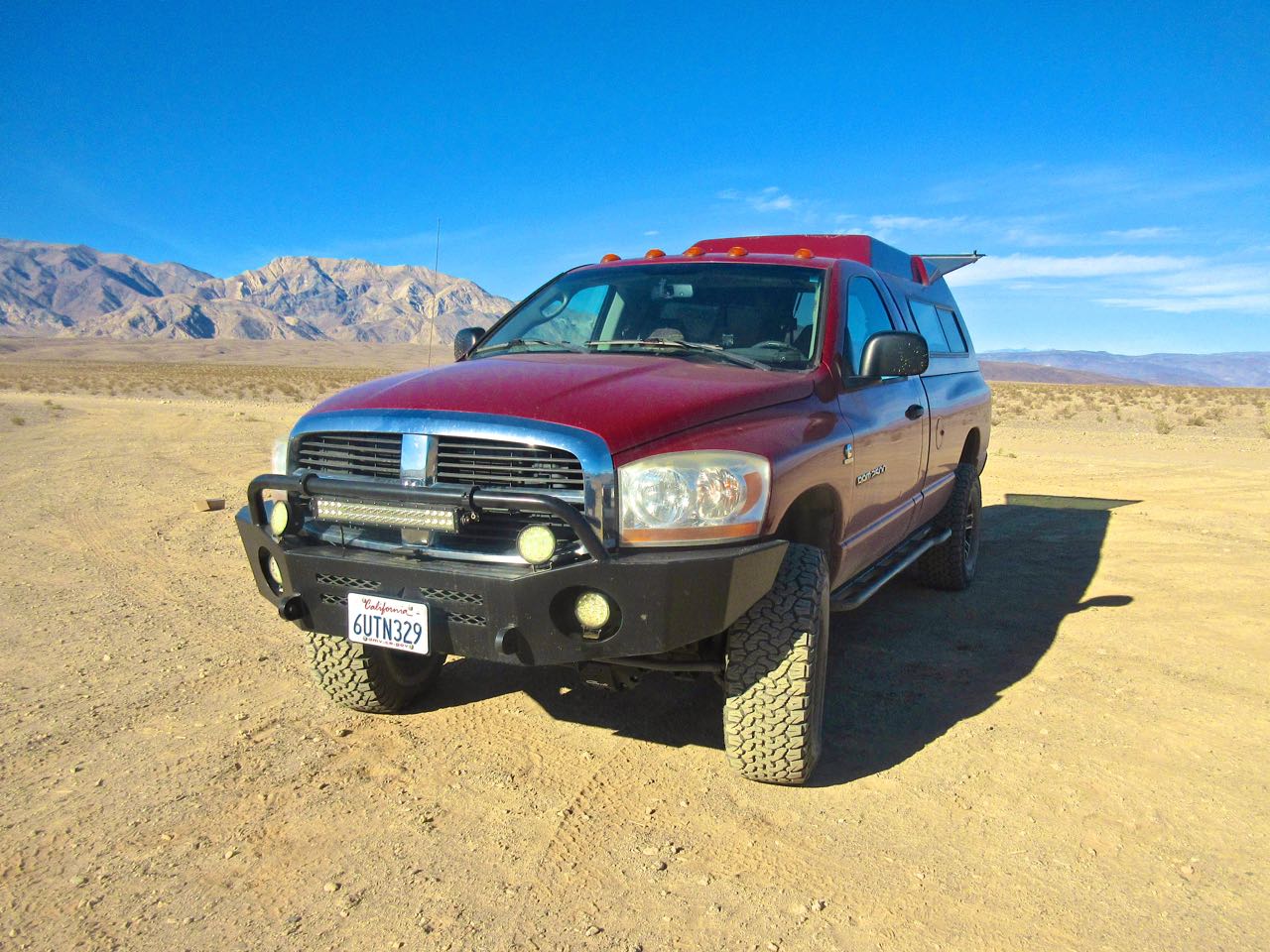
Final Build: 2006 Dodge Cummins 2500 G56 6 Speed Manual Transmission Standard Cab Long Bed

**************************************
LUBRICANT FOR G56 TRANSMISSION:
There has been much controversy regarding lubricant selection, with many owners and industry experts arguing that using ATF+4 to lubricate the transmission, as Chrysler recommends, can cause it to fail prematurely. Mercedes-Benz recommends a thicker 75W or 90W gear oil in their trucks that are equipped with the G56. It is debatable whether anything is gained by switching to a 75W/90W gear oil, but many owners choose to do so. A tooth was removed from the input shaft gear for the 2007.5 model year, resulting in a ratio change for the 6.7L Cummins version. When equipped in 6.7L applications, torque was derated to 610 lb-ft for 2007.5 to 2012 model years, and has been derated to 660 lb-ft for 2013 to current model years. Meanwhile, the Cummins Turbodiesel is available with up to 900 lb-ft equipped with an automatic transmission.